

ROI in real estate is historically one of the most popular way for making money. In fact, India’s real estate is anticipated to be around USD 1 Trillion by 2030.
When an investor starts exploring market, the concept from owning property moves from simply owning a property to gaining a revenue from it. And now a day one of the first things a buyer will ask is “What would I get in terms of ROI”Builders and brokers very well understands this.
But ROI is not all. You must always consider other aspects such as location growth, tenant demand, vacancy risk, infrastructure development and sale potential etc.
If investor understands ROI then it can guide him to move beyond the marketing gimmick and decide well.
How Builders and Brokers Use ROI in Real Estate Sales
The concept of ROI is the biggest selling proposition in today’s real estate marketing. This is because investors are currently highly interested in rental yield and cash flows.
Due to this reason, sometimes even before showing the property and its potential, builders and brokers claim the returns.
Words like ‘10% assured return’, ‘guaranteed rental income’, ‘earn from day one’ attract potential investors as it makes the deal look safe and rewarding.
Due to this many of the buyers end up comparing with income promised rather than asking questions such as about location, tenant demand, future growth of the property or its resale value.
Though not all the high-ROI propositions are misleading, as in many cases, the properties give good returns due to high demand and the area has a good future growth. But an investor must always remember that the ROI is just an approach to lure the buyers.
It is advisable to ask the simple question of how the property yields the return, the answer of which speaks more about the investment than the percentage of ROI.
New terms used to attract investors
Investment focused terms are becoming common in sales presentations and property advertisements due to competition in the real estate market.Investors can make more informed decision if they understand these commonly used terms.
1. Guaranteed ROI
Guaranteed ROI is where a builder/developer guarantees a certain amount of return on your investment for a certain duration of time, following the purchase of the property.
Sometimes it’s marketed as a low-risk investment opportunity, which can give you regular income. However investors need to have a very careful look at how this is going to be paid for.
In this case these schemes look very lucrative because they offer some security of a return, the cost of which is often already incorporated in the selling price of the property and it is the buyer who is indirectly funding the promised return on the property investment.
This understanding of where your returns are going to be coming from, for how long and what is going to happen at the end of the period the returns are guaranteed for, needs to be sorted out beforehand.
2. Pre-Rented Property
A pre-rented property means we sell you with the current tenant still there. A pre-rented property is considered good because immediately when we purchase it we get an instant rental income.
As a real estate entrepreneur, Mr Rahul Giri said in Hinjewadi Phase 3, there is an investor property with the description: we will be doing an agreement with the managed co-living company, and they will provide monthly rental income of nearly 29,500/- per month with an investment of 69-70L.
Although pre-rented properties seem like a win-win investment, one should not consider the income to be stable over the years. You need to review lease terms, tenants’ credit, payment terms, possibility of lease renewal, etc.
A good tenant with a sought after location can be a dependable source of income but a poor tenant with unstable location can pose risk of vacancy over the years to come.
3. Assured Returns
Assured returns schemes offer an investors a guaranteed monthly or annual income for a set period of time. Typically used as incentives to lure potential buyers to invest in products or services requiring long cash flow commitments.
As an investor it is essential to grasp the business model that backs up the assurance. Assured returns often function more as a marketing tactic intended to drive sales than as an indicator of true market demand.
Careful study of the terms and conditions of such schemes will assist investors in maintaining realistic expectations and in determining the actual source of the returns.
4. Passive Income Property
It’s a term heavily utilized by the real estate marketing community, as it draws the attention of individuals who are trying to find more sources of cash flow.
These are properties that are advertised as “real estate with little landlord effort generating consistent cash flow from tenants.”
Real estate is never totally passive, however. Any number of expenses or property-management tasks-such as building maintenance, management of tenants, vacancies, taxes, operating costs, etc.-will affect actual cash flow.
Real estate cash flow may indeed be passive, but no real estate exists that is not at least a bit of a pain in the neck, with attendant responsibilities.
5. Leased Investment Opportunities
The term leased investments refer to the purchase of a property with a tenant who already holds a valid lease.
Such properties are often marketed as secure investments providing immediate income streams because of the tenant in place.
Although the current tenant will offer some degree of short term certainty to the investment, a potential purchaser must be aware of the financial viability of that tenant, how long the tenant will occupy the premises (term of lease) and the overall conditions of the market within which the business is conducted.
Ultimately a tenant’s lease is only worthwhile if the tenant remains a thriving and solvent business.
6. Fractional Ownership Concepts
Fractional ownership enables different investors to co-invest in a valuable property by investing smaller amounts of capital.
Fractional ownership has become favorable due to enabling access to high-end commercial and real estate property that an investor might otherwise be unable to access on an individual level.
While fractional ownership may present advantages in terms of accessibility and diversification, it is essential that investors be familiar with the legal structure, ownership rights, exit strategy, profit distribution scheme and limited liquidity.
Only Investing For ROI will bring these problems
ROI is a good measure but should not be the only factor in deciding to buy or not buy investment property.
A high figure for ROI in a sales pitch looks good, but not necessarily an indicator of a good long-term investment. The most common error investors make is to only consider expected rental income but fail to look at other factors.
Some properties yielding very good return on investment can be in an area with low demand or high supply making the return hard to maintain. Many advertised ROI numbers are not taking into account operating expenses such as maintenance, property tax, vacancies, repairs, etc which means the true return may be lower.
Successful investors are ones that take a step back and look at the whole picture, making the ROI merely one of many deciding factors instead of the only determining factor.
Solid market conditions, constant demand, and steady growth are of much higher significance than numbers printed in a brochure.
Step-by-Step Process to Follow Before Investing
Real estate investment is not something of chance. Almost all the investors use some system to make the decisions on opportunities they analyze.
It makes sense to buy the property for years, for that the property should be desirable and demanded for years. And one should not buy the property only today. Rental Income should not be the only and high priority thing.
1. Understand Why the Location Is Growing
For any thriving market in real estate there always a reason why the market is on an upswing. So while investing you should first identify what is actually driving the market at that location.
This drive can either be due to a burgeoning business hub, IT parks or any other industrial growth, education, healthcare facilities or just population.
Taking an example: with the entry of huge IT companies like Wipro, Infosys and TCS at Hinjewadi, the demand for housing has surged in adjacent areas like Wakad, Tathawade and Marunji as most employees preferred to reside near their workplaces.
Similar is the case with other commercial activities creating a demand for office space, retail stores.
Thus one should always go for an investment only in locations where demand has real support due to some real business or economic growth rather than merely market psychology.
2. Check Future Infrastructure and Connectivity
Infrastructure development can also be a significant factor in determining demand in future. Infrastructure like new Metro lines, highways, airports, Railway station, Commercial Centers add on the future desirability and reach of an area.
Many properties achieve great appreciation not based on its current state but on upcoming infrastructural projects that would connect them better.
For instance It is proposed that the Metro line will be extended from Bhakti-Shakti chawk to Ravet, Punawale, Tathawade and also till Bhosari MIDC and Chakan MIDC, due to this reason properties have seen a growth from its announcement itself.
Personal Tips :- The investor must research upcoming government projects, transport plans and other development activities that may have a positive impact on the region’s growth in the future.
3. Analyze Business and Tenant Demand in the Area
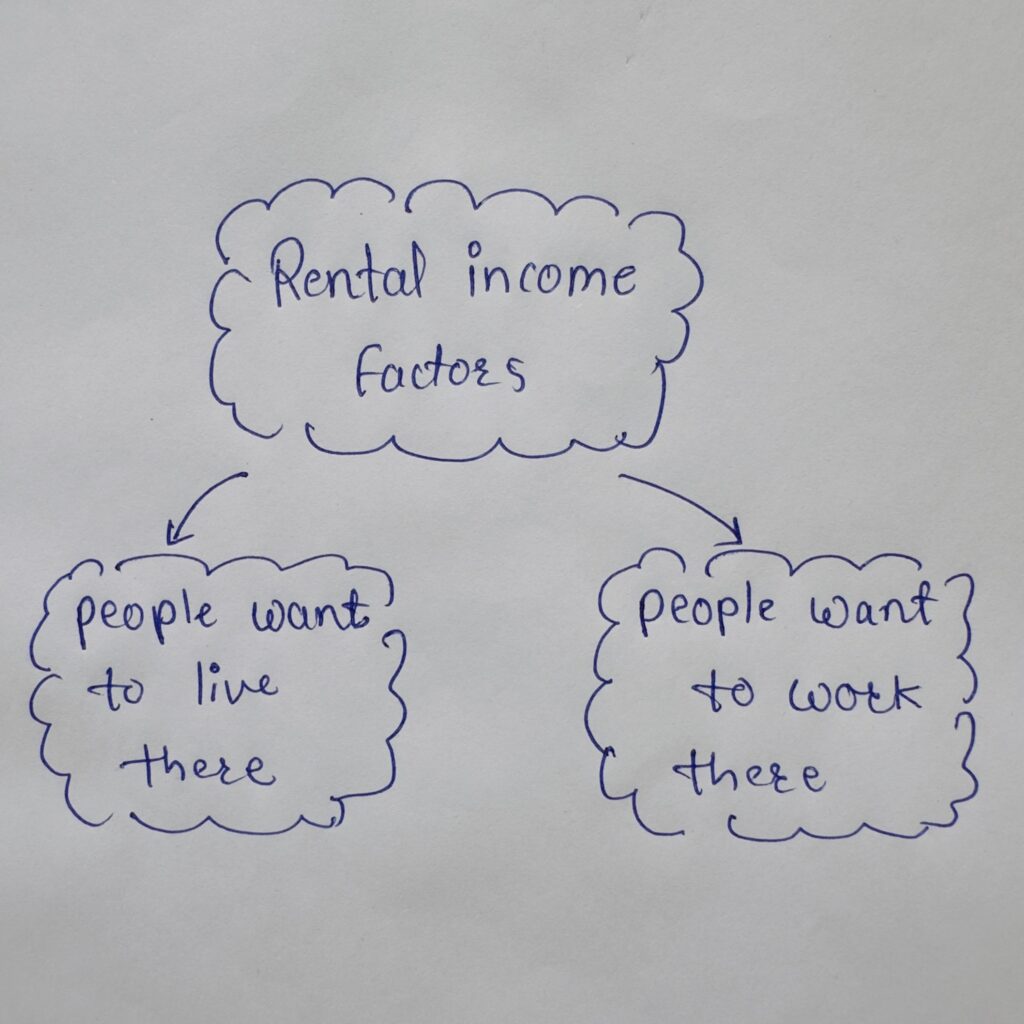
Rental income depends on simple factors:
- People want to live there
- People want to work in that location.
Employees who work nearby companies contribute more to rental appreciation. Educational institutions, hospitals, business parks, and commercial activity also play a vital role. It becomes difficult to maintain a stable occupancy rate without consistent demand.
For example, areas like Wakad, Tathawade attract employees working in Hinjewadi or Baner location meanwhile commercial property is benefited by nearby business activities.
If an investor understands who the potential tenants are. And why will they choose the location? It is an important part of investment analysis.
4. Check Vacancy Risk and Oversupply Situation
No returns can be made on a property unless it is occupied. Vacancy risk therefore should always be considered.
Investors need to look at how many properties like their own are being developed in the region and if demand is falling behind supply.
High competition for tenants could put rental income and occupancy levels under pressure.
For Example, if there are more commercials being developed in the location than there is demand for in that condition it will mean that the tenant has more choice, which will diminish rental returns in the longer term, even if they seem attractive on launch.
Investors need to consider the equilibrium between supply and demand to consider long term viability.
5. Compare Property Pricing With the Surrounding Market
Investors may fall for attractive marketing methods. This can blind the investors, making them forget about checking out similar properties in the area, which results in an inflated price being paid.
It’s a good practice to look at other comparable projects in the region before closing any deal. Analyzing the rates in the local market gives you a feel whether you are being charged the right price, or overpaying the due to over enthusiastic marketing of a property, or properties being sold on a ROI based plan.
A property bought at the right price can provide better returns and much greater peace of mind.
6. Verify Builder Credibility and Project History
Real estate investments are as good as the developer it is made with.
A good location turns a bad investment in case the builder has history of delays, litigation or shoddy construction.
Potential investors must do thorough research on past constructions by the developer, delivery timelines of existing projects, customer feedback and general reputation.
A reputable builder has the ability to add value to the investment over a period of time.
7. Evaluate Rental Sustainability Instead of Initial ROI
It is common to be very enthusiastic upon discovering a property that returns high rental value from day one.
The initial returns for a few years can be very attractive due to sales promotions, short term needs or because you have bought at the best part of the market cycle.
But if rental demand falters then you won’t be able to sustain the initial yield. Sustainable returns often carry more long term wealth than high potential future yield.
8. Analyze Long-Term Appreciation and Resale Potential
Rental returns is just one aspect of property investment. A good investment must also have the prospect of capital growth.
Properties located in areas with good growth, good infrastructure, employment and population increases tend to appreciate well, compared to stagnant properties.
Investors should also take into consideration resale demand. Properties may make a good rental income now, but is there going to be someone else who buys it later on? A property that may be difficult to sell is going to offer limited exit options.
The ideal property is an investment which combines both a steady stream of cash flow and the prospect of capital growth.
9. Verify Legal Documents and Hidden Operational Risks
No real estate investment should be made without proper legal verification.
For any purchase of property by any investor he needs to examine the ownership papers, clearances, permits, RERA registration number and title deed along with pending liabilities on the asset.
Overlooking legal issues can create financial and operational challenges in the future.
Where there appears to be a feature there just for show, that property should be carefully investigated so that no potential problems are inadvertently brought in. Rigorous investigation is one of the key features of any investment project.
How Vacancy Risk and Oversupply Affect Real Estate ROI
Vacancy risk refers to the chance of your property being vacant for some time. During the period the property is vacant, you won’t receive any rental income but the expenditure on ownership must be paid.
Maintenance charges, property taxes, insurance expenses and the installments on the home loan need to be paid, regardless of whether you earn cash flow from the property or not. Just a few months of vacancy can have a detrimental impact on your annual returns.
Another issue you may face is oversupply of a particular type of property in your market. This happens when more than enough supply of similar properties are available. Because of the increased competition the landlord may have to reduce the rents or provide incentives to attract tenants.
For instance, If a number of commercial properties are constructed in Chinchwad in a large number within a short duration. Then the demand by tenants would get diluted among many others and thus the vacancy rate would drop and the growth in rent would slowdown.
This is why investors should look beyond advertised ROI figures. They should study about market. And ask can realistically this property support long-term tenant demand?
Why Some High ROI Properties Face Resale Problems
One mistake that investors make is believing that if a property can bring in significant rentals then it will be easy to resell later on.
High-ROI properties are usually purchased by investors who find it hard to resell if there are many properties on the market of a similar nature.
In other cases, the attractive ROI returns might simply be due to the lower property price-there is nothing that inherently makes low priced properties have demand in the future.
In some cases, promotional schemes drive up rentals artificially for a set period.
It is essential for investors to consider long-term demand, appreciation and exit potential rather than simply rental yield.
Hidden Costs Investors Ignore While Calculating ROI
A lot of ROI calculations presented in sales pitch have taken into account only the rent and purchase prices.
The results of such ROI calculation may make it appear as though returns were very good but in reality have some cost factors that will surely impact on the profits.
Some common expenses often ‘conveniently’ ignored are:
- Maintenance charges
- Taxes
- Repair and renovation costs
- Insurance costs
- Brokerage fees
- Legal costs
- Property management fees
- Vacancies
- Interest payments on loans
- Common area maintenance charges.
For example if an advertisement for property suggests that the returns were about 10%. Then the net return could be very much less after the deductibles above are removed. Smart investors consider return on Cash flow instead of the gross rent.
Why High ROI Does Not Always Mean Better Investment?
It’s common for many people to assume that because an property is showing higher ROI, then it’s the superior choice. However, real estate investing is somewhat more involved than simply analyzing percentages and making a judgment.
Higher returns can often be due to artificially low prices or special offers during promotional periods.
Properties that yield a moderate ROI can potentially be a greater source of wealth if it is situated in a highly appreciating market. Such a scenario would likely require a long-term outlook on potential appreciation and rental demand.
That is why seasoned investors research the fundamentals behind a return instead of simply considering the returns alone. The performance of a sound investment should stem from solid market fundamentals andROIis just one result of these fundamentals.
Difference Between Income-Generating Property and Wealth-Creating Property
| Factor | Income-Generating Property | Wealth-Creating Property |
| Main Objective | Generate regular rental income | Build long-term wealth and appreciation |
| Investor Focus | Monthly cash flow | Long-term value creation |
| Location Selection | Often based on rental yield | Based on future growth potential |
| ROI Attraction | High ROI is the primary selling point | Appreciation and demand are key drivers |
| Rental Demand | Important but may fluctuate | Supported by long-term market growth |
| Appreciation Potential | Usually moderate | Generally higher |
| Resale Opportunities | May be limited in some markets | Often stronger due to broader demand |
| Risk Exposure | More sensitive to vacancy and rental fluctuations | More dependent on long-term growth trends |
| Investment Horizon | Short to medium term | Medium to long term |
| Wealth Creation Potential | Generates income | Builds long-term assets and equity |
The best investment is a combination of both characteristics. They provide stable rental income while also benefiting from future appreciation and increasing market demand.
Why Developer Credibility Matters in Real Estate
A reliable builder offers quality of construction, adherence to legal guidelines, timely possession, transparency of deals in any project and also reflects the long-term worth and marketability of property.
Do your research on the developer, his profile and track record before committing investment in property. Past projects, project completion records, client response, legal standing can give a good idea of the builder’s trustworthiness.
Projects executed by good developers also find more faith with buyers, resulting in higher demand during resale of property. Properties developed by builders, known for project delays, legal issues, lack of quality in construction may fall short even in a potential market.
While the trustworthiness of a builder may not be part of the ROI formula, it may have a huge role to play in a property investment.
Questions Investors Should Ask Before Investing
Before making a decision on an opportunity you should consider taking a look at it from all angles. Asking the right questions will make you aware of risks that are not mentioned in sales pitches. Some things that you could consider asking are:
- Is the location a growth area for population, jobs and infrastructure?
- What are the demand drivers for this market?
- Who is the typical tenant for this property?
- Is the demand for rental income stable, or based on temporary factors?
- Is the supply overabundant in the immediate area?
- What are the occupancy levels in neighbouring developments?
- How does the price per square foot compare to similar projects?
- What backs the claims on projected ROI being marketed?
- Is there long-term resale demand?
- How easy is it likely to be to exit this investment?
- What is the developer’s history of completion?
- Have all registrations, approvals and legal documents been verified?
- Can the property hold value in a slow market?
When they are able to answer these questions, the information you gain will provide far more information about an investment than any ROI figure will.
Final Thoughts From Rahul Giri, If You Want to Buy or Exit an Investment
ROI matters but should not be the sole reason to invest in real estate. Sound investments focus on a growing market, demand, infrastructure and a strong resale value. The best investors look for strong assets and view ROI as a result of good investments, rather than look for high ROI and make the real estate asset second. In real estate wealth is derived from a sound asset.

