

Mutual funds are a widely used investment asset class by traders and investors as compared to the stock market. Mutual Funds are safer than stocks, which means more diversified. In the long term, stocks will generate more return on investment, but mutual funds are very safe.
Ketwich founded a mutual fund-like structure for small investors to mitigate their risk in 1774 in the Netherlands. Van Ketwich’s innovation came into play in the early 1800’s for investors to park their money in shares.
Today, mutual funds are playing a dominant force in global economics, with trillions of dollars in assets under management. Technological advancements have further democratised investing in mutual funds, allowing individuals to invest in funds through online platforms with minimal fees.
Additionally, new categories of funds like index funds, ETFs such as socially responsible funds and target-date funds have emerged to meet the evolving needs of investors over time.
What are mutual funds?
Mutual Funds refer to a pool of investors’ money that is parked into a group of companies to mitigate risk and give higher returns with less knowledge about financial markets.
It is managed by qualified professionals who invest money to get higher returns on low investment and charge commission.
There are many types of mutual funds based on return, risk and liquidity. Equity Funds, Debt Funds, Hybrid Funds, Index Funds, Liquid Funds.
Equity Funds primarily invest in shares based on large-cap, mid-cap and small-cap companies. Equity funds are very risky because their underlying asset in companies. When economic activities are slowed down, then companies’ revenue is impacted, and mutual fund returns also go down.
Debt Funds invest in fixed securities like bonds. Hybrid Funds are a mixture of both equity and Debt. Index Funds are a copy of an exchange index. Liquid Funds are treasury bills, commercial papers and certificates of deposits.
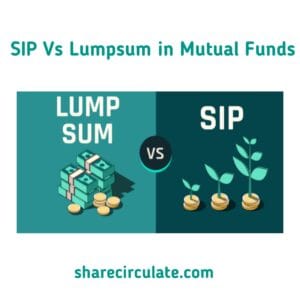
In mutual funds their are two ways to invest money: first, one is through SIP, and second is lump sum or one-time.
What is SIP ( Systematic Investment Plan )?
Systematic Investment Plan (SIP) is a disciplined approach of investing a fixed amount of money into funds at a fixed date by investors. SIP investment doesn’t required to trace stock market from time to time because you don’t need to worry about major events. SIP mitigate and gives average returns on a yearly basis. It is automatic and done by the bank if you give them permission.
What is a lump sum in Mutual Funds?
A lump sum is a one-time investment into a mutual fund and is made by humans. You can invest a large amount of money into funds without restriction, like SIP.
A lump sum removes the flaws of SIP and gives more chances to invest when the market falls due to sudden events. If anyone has a large amount, then he can invest at one time to get the same NAV value for a large amount of money. You can check your Returns through Star SIP Calculator to get detail understanding of your investments.
Difference Between SIP and Lump-sum Investments
Comparison Between SIP and Lumpsum Investment in Mutual Funds for beginners to make correct and inform decision in their investment journey without mistakes.
| Feature | SIP (Systematic Investment Plan) | Lumpsum Investment |
|---|---|---|
| Investment Mode | Regular, periodic investments (monthly, weekly, quarterly) | One-time bulk investment |
| Risk Management | Lower risk due to rupee cost averaging | Higher potential gains if invested early, and the market grows |
| Market Timing | No need to time the market; spreads investment over time | Higher risk as an investment is made at a single market price |
| Volatility Impact | Less impacted by market fluctuations due to staggered investments | More impacted by market volatility if invested at a high point |
| Compounding Benefits | Benefits from long-term compounding with small, consistent investments | Higher potential gains if invested early and the market grows |
| Affordability | Suitable for all investors; can start with as little as ₹500 per month | Requires a large sum of money upfront |
| Flexibility | Investors can increase, decrease, or stop SIP anytime | No flexibility after the investment is made |
| Emotional Control | Encourages disciplined investing and avoids impulsive decisions | Investors may panic and redeem in case of market downturns |
| Best Suited For | Salaried individuals or those with regular income | Investors with surplus funds and risk appetite |
It depends on investors; if they have less knowledge and don’t have much time to trace the market, then choose SIP.
Otherwise Lumpsum is best if you trace on a daily basis. A lump sum gives more returns than SIP because you buy NAV when the market falls and don’t invest when the market is up, which means you’re averaging only when the market falls.
What Taluka and Villages People Choose SIP or Lumpsum?
Generally, People in Lonar, Mehkar and Buldhana have less knowledge and think about land investment more than stocks and mutual funds. But Generation Z and Millennials learn and start investing in equities.
But very few people are really educated and do proper research before investing. Many of my friends ask me, “Pavan, tell me fast shares, I don’t care about risk and market cap. I want to make money fast, but I don’t know much about those stocks’ fundamentals.” These are the words said by them, and I told them directly that I don’t do that.
One of the worst experiences in my village are i taught my friend about mutual funds. He doesn’t know about mutual fund risk and returns, but he says he just told me I follow you, and I don’t care about negative returns and never sell my mutual fund portfolio.
He invested 10k in a lump sum with my advice, after 3-6 months the market surged upward, and his portfolio was in profit, but then after 1 year the market correction happened, then he was in loss, and he say pavan you don’t have proper knowledge in the market and critise my in my hometown, Dhanora. From that day, I learned never to advise half-knowledge people about the stock market and mutual funds.
Risk and Volatility Comparison
SIP reduces the impact of market volatility by spreading investments over different market levels. This makes SIP relatively less risky in the short to medium term. Lump-sum investments, on the other hand, face full market risk immediately. Market crashes shortly after investment can affect returns significantly.
For investors who are uncomfortable with volatility, SIP provides a smoother investing experience.
Returns: SIP vs Lumpsum
In the long term, both SIP and lump sum can deliver similar returns if the total invested amount and investment duration are the same.
A lump sum may outperform SIP in a steadily rising market, while SIP performs better in volatile or uncertain markets. The key factor is staying invested. Consistency matters more than the method chosen.
Liquidity and Flexibility
SIP offers greater flexibility. You can start, stop, increase, or decrease SIP amounts easily. Lump-sum investments require the availability of a large amount upfront and offer limited flexibility once invested.
Tax and Goal-Based Planning
From a taxation perspective, SIP and lump-sum investments are treated the same. Taxes depend on the type of fund and holding period, not on the investment method. For long-term goals like retirement, SIP is often preferred. For short-term goals or surplus funds, lump-sum investments may be suitable.
Which Is Best for You?
- Choose SIP if you want disciplined investing, lower risk, and steady wealth creation.
- Choose Lumpsum if you have surplus money, strong market understanding, and a long-term horizon.
- A combination approach works best for many investors—SIP for regular income and lump sum during market dips.
Final Conclusion
There is no one-size-fits-all answer to SIP vs lumpsum. For most Indian retail investors, SIP is the safer and more practical choice, while lump-sum investments can enhance returns when used strategically. The best method is the one that aligns with your financial goals and helps you remain invested through all market cycles.
Disclaimer: Investment in Mutual Funds is subject to market risks. Please read all scheme-related documents carefully before investing. This article is for educational purposes only and reflects the personal experiences of the author.

