

IT Companies play a crucial role in the economy. American IT Companies contribute 10% in gross GDP, while India has a market share of nearly about7.5%, and that will increase to 10% till FY2025. America have more IT Companies than any other country because of their capitalist culture.
There are three types of information technology companies: the first is Product-Based, the second is Services-Based, and the last is new Hybrid-Based.
Product-based companies have their own product, and they do not outsource their operations. Service-based companies provide services to other companies; in fact, their core business is to solve problems faced by companies in every sector, like BFSI, Telecom, Infra, Manufacturing, etc.
Hybrid-based companies follow both models mentioned above, combining elements of both service-based and product-based businesses.
Top 10 American IT Companies Based on Market Cap
While considering market cap, you must understand that market cap fluctuates on a day-to-day basis because of stock price movement. Some ups and downs may be happen in those companies. Ownership is based on shareholding patterns.
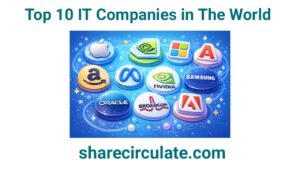
Most of the IT Companies are owned by the Vanguard Group. Apple has the highest market cap and is still at the top after NVIDIA’s stock falls.
| Rank | Company | Market Cap (April 2026) | Trend/Notes |
| 1 | NVIDIA | $4.4 Trillion | NVIDIA became the world’s biggest company because of AI chips. |
| 2 | Apple | $3.8 Trillion | Because of their new innovative products |
| 3 | Alphabet (Google) | $3.6 Trillion | AI Mode and Gemini Launch |
| 4 | Microsoft | $2.8 Trillion | Slight dip compared to NVIDIA but stable. |
| 5 | Amazon | $2.3 Trillion | Driven by AWS AI infrastructure. |
| 6 | TSMC | $1.8 Trillion | Essential “picks and shovels” for the AI era. |
| 7 | Meta | $1.5 Trillion | New entry to the Top 10 due to AI networking. |
| 8 | Tesla | $1.4 Trillion | AI and Robotics company now |
| 9 | Broadcom | $1.4 Trillion | New entry to Top 10 due to AI networking. |
| 10 | Oracle | $413 Billion | Cloud infrastructure surge. |
Top 25 Indian IT Companies By Market Capitalisation
Most Indian businesses have service-based IT businesses. Azim Premji and Narayan Murty started the IT revolution in India back in the 1990s. All indian market caps were in rupees, while Americans have them in dollars.
| Index | Companies | Market Cap |
|---|---|---|
| 1 | TCS | 15 Lakh Crores |
| 2 | Infosys | 6 Lakh Crores |
| 3 | HCL Technologies | 4 Lakh Crores |
| 4 | WIPRO | 2.3 Lakh Crores |
| 5 | LTIMindtree | 1.4 Lakh Crores |
| 6 | Tech Mahindra | 1.1 Lakh Crores |
| 7 | Oracle | 69 K Crores |
| 8 | Persistent Systems | 60 K Crores |
| 9 | L&T Tech | 57 K Crores |
| 10 | Tata Elxsi | 46 K Crores |
| 11 | Mphasis | 45 K Crores |
| 12 | Tata Technologies | 43 K Crores |
| 13 | KPIT Technologies | 39 K Crores |
| 14 | Coforge | 37 K Crores |
| 15 | Cyient | 22 K Crores |
| 16 | Sonata Software | 20 K Crores |
| 17 | Birlasoft | 19 K Crores |
| 18 | Affle India | 14 K Crores |
| 19 | Firstsource | 14 K Crores |
| 20 | Intellect Design | 13 K Crores |
| 21 | Zensar Technologies | 13 K Crores |
| 22 | Tanla Platforms | 12 K Crores |
| 23 | Happiest Minds Tech | 12 K Crores |
| 24 | Newgen Software Tech | 10 K Crores |
| 25 | Route Mobile | 9 K Crores |
How AI Shifts the Focus of Developers from Basics to Prompt Engineering?
Before Nov 2022, generative AI was introduced in the market everything was working well. At that time cloud was showing fast growth, and all information was found on Google, and developers needed more time to solve even basic queries. But OpenAI launches their generative AI Model ChatGPT in mid nov, and it took viral growth in January 2023.
After that, most of the companies shift their focus from basics to prompt engineering, which means they teach their employees about how to use AI and increase productivity.
But AI will solve all problems of developers, and it improves production and works fast. Many developers now rely on AI to solve their coding problems.
Indian IT companies started making their own models and expanding their business in the AI segment to sustain. As of now, in April 2026, Antropic AI is disrupting the whole industry and Many IT professionals fear for their job layoff and survival.
Major Problems with IT Companies Because of Heavy Investment in AI Segments?
Currently, many companies are in a race to make their own generative model without knowing the market demand and sustainable growth outcome. Investors put money without knowing their cash flow and net profit growth. It now feels like an AI Bubble similar to the Dot Com Bubble in the 2000s.
If companies don’t meet market needs, then they will fall, and because of that, investors will lose their money by following herd mentality.
Usage costing of many companies, like OpenAI and Antropic, is very high; they currently limit their free users’ requests to manage their operating costs with negative profits.
Comparison: 2000 Dot-Com vs. 2026 AI Boom Possibly
| Metric | Dot-Com Bubble (2000) | AI Boom (2026) |
| Profitability | Most companies had zero profit. | Top players (NVIDIA, Google) are highly profitable. |
| Funding Source | Cheap VC money and IPO hype. | Massive debt and cash reserves of Big Tech. |
| Main Problem | No real customers or products. | Extremely high costs to keep the product running. |
| Market Risk | Total collapse of “fake” companies. | Margin squeeze for real companies. |
Look at the above comparison chart of the Dot-Com bubble and the AI Boom. In the Dot-Com bubble, most companies had zero profit and revenue, meaning people bought domains and then they built companies, and investors just invested on the basis of domains.
On the other hand, AI Boom is not like the top players in the AI segment is good at profitability, but individual players are in high revenue and negative profits.
The funding source of the Dot-Com bubble is limited to VC and IPO hype, while AI Startups taking money from Big Players of IT Companies. If they don’t meet their requirement, then a fall in the stock prices of big players is possible.
No real users on the websites in the Dot-Com bubble companies, while AI have high users, but managing them is extremely high for companies.
How do my IT Friends and Family Members Handle the AI Boom in 2026?
My brother Vaibhav Padghan, Sandesh Kokad, Karan Rai and Santosh Garole are all software developers, some are DevOps Engineers. They learn AI to keep them updated with the latest technology.
Vaibhav Padghan Said on the linked post, ” AI shouldn’t write your architecture. It should help you validate it. In 2026, the real problem is not generating code from AI, but using AI to handle stress test situations.”
Santosh Garole, Senior DevOps Engineer, said, ” AI help us to automate many things in the DevOps landscape. In the future, I will quit my job and do farming.”

