

I believed in high Price to Earnings Ratio companies in 2020, because I feel they give high returns and are emerging companies. I followed this strategy while investing in company stocks. I made profits from this strategy.
My strategy was simple: pick stocks that have more than 40 price to earnings multiples, growing revenue, high net profit margin, low debt ratio, high free cash flow, is high and lastly, current assets should be greater than current liabilities. I picked so many stocks and also made profits from them, which you can see in the screenshot.
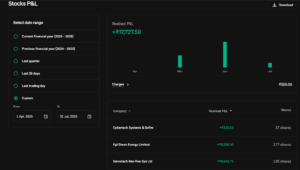
We made a profit of 9K in KPI Green Energy from April 2025 to July 2025 and 8k in Servotech Renewable Power Systems in the same period. The motive behind sharing this screenshot of Groww profits is that both stocks have a high PE ratio at that time and are the fastest-growing stocks.
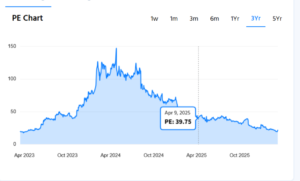
KPI Green Energy had 39 PE at that time, and I believe it will go down when earnings increase annually.
Similarly, in Servotech Renewable Power Systems, I made a profit of over ₹8,000. This stock was even more “expensive” by traditional standards, trading at a PE multiple of 91. Despite the high valuation, the growth momentum was so strong that the “High-PE” strategy worked perfectly. These wins didn’t just give me money; they gave me a dangerous level of confidence. I had recovered my previous losses and was finally profitable. I felt I had mastered the art of “Growth at any Price.”
Happiest Minds Technologies’ main problem arises
Happiest Minds Technologies is one of the leading AI companies in India. They provide generative AI and Agentic AI solutions across the world. They have established a client base in the USA and Europe.
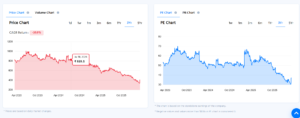
I invested my 75% amount in one stock, before that I never took that much risk, but based on my past return, i assure and take an investment bet on Happtest Minds Tech.
When I entered Happiest Minds, the stock was trading at high valuations, consistent with my high-PE strategy. I looked at the charts—the stock was around ₹828 in July 2024—and I believed that the AI revolution would push it to new heights. However, the market had other plans.
As the stock price of Happiest Minds began to slide from ₹800 to ₹700, and then toward ₹600, I didn’t see a warning sign; I saw a “discount.”
I told myself, “If I liked the company at ₹800, I should love it at ₹600.” I continued to pour my remaining liquidity into the stock, trying to bring my average purchase price down. I was convinced that the market was “wrong” and I was “right.” This is the classic Sunk Cost Fallacy. Instead of admitting that the fundamental environment for high-PE IT stocks had changed, I doubled down on my mistake.
By averaging down, I didn’t just lower my entry price; I increased my total exposure to a falling knife. When you are already 75% concentrated in one stock, averaging down is like trying to put out a fire with gasoline. It tied up every rupee I had, preventing me from investing in other sectors that were actually recovering. By the time the stock hit its lows, I was not just looking at a percentage loss; I was looking at the erosion of my hard-earned savings. I used my stock average calculator for averaging down because it gives accurate results, and before taking a position in stocks.
The Reality of Multiple Contraction
As you can see in the PE chart for Happiest Minds, the valuation didn’t just “compress” through higher earnings; it collapsed through a falling stock price. The PE ratio, which had been comfortably in the 50s and 60s, began a steady and painful decline.
What went wrong? Several factors combined to create the perfect storm:
- High Expectations: When a stock has a PE of 60+, it is priced for “perfection.” If the company grows at 20% but the market expected 25%, the stock price falls. In the case of Happiest Minds, the global IT spending slowdown and concerns about AI monetisation started to weigh on sentiment.
- The Geopolitical Shock: As I noted in my earlier analysis, global events like the Iran-Israel conflict create a “Risk-Off” environment. In such times, investors flee from high-PE “expensive” stocks and hide in “cheap” value stocks.
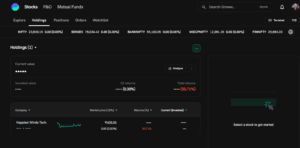
- The Long Decline: The stock price began a consistent downward trend. My Groww screenshot tells the final, painful truth: Total Returns: -50.71%.
I had watched half of my total invested capital vanish. Because I had put 75% of my money into this one stock, my entire portfolio was devastated. The profits I had made from KPI Green and Servotech were not just erased; they were buried under a mountain of new losses.
Lessons from the Grave of a 50% Loss
Losing 50% of your capital in a single stock is a traumatic experience for any investor. However, if you don’t learn the lesson, the loss is truly wasted. Here are the core pillars of what I learned from the Happiest Minds disaster:
1. High PE is a “Confidence Multiplier,” not a Safety Net
A high PE ratio means the market is confident about the future. But confidence is fragile. When a company trades at a PE of 90, you are not buying the company’s current value; you are buying a promise of future greatness. If that promise is delayed by even a few months, the market will punish the stock mercilessly. High PE stocks are excellent for bull markets, but they are the first to be slaughtered in a bear market or a period of sideways consolidation.
2. The 75% Rule (Or Why You Should Never Have One)
Never, under any circumstances, invest 75% of your capital in a single stock—no matter how much you “believe” in the story. Even if the company is the best in the world, external factors (war, regulatory changes, management scandals, or global recessions) can destroy the stock price. Diversification is the only “free lunch” in investing. It protects you from being 100% wrong on a single bet.
3. Price is What You Pay, Value is What You Get
I was so focused on the strategy (High PE + Growth) that I forgot the price. I bought Happiest Minds when the hype was at its peak. By buying into the “AI Hype,” I was the “exit liquidity” for smarter investors who had bought the stock when it was unloved and cheap.
4. The “Averaging Down” Fallacy
When the stock started falling, my instinct was to “average down” because I believed in the company. But when you are already 75% concentrated, averaging down is just throwing good money after bad. It increases your exposure to a sinking ship.
Moving Forward – The Balanced Investor
The experience with KPI Green and Servotech made me profitable, but the experience with Happiest Minds made me a better investor.
I have realised that while high-growth, emerging companies are exciting, they must be balanced with Margin of Safety. You can still use the High-PE strategy, but it must be governed by strict position sizing. No single stock should ever be more than 10-15% of your portfolio, regardless of how “fast-growing” it is.
My New Checklist for Recovery:
- Cap Your Exposure: No “All-In” bets. Ever.
- Watch the PEG Ratio: Instead of just looking at PE, look at the Price/Earnings to Growth (PEG) ratio. A stock with a PE of 40 growing at 40% (PEG = 1) is much safer than a stock with a PE of 40 growing at 10% (PEG = 4).
- Emotional Detachment: I loved the “story” of Happiest Minds AI. I fell in love with the stock, and love is a dangerous emotion in the market. You must be willing to cut your losses when the technical or fundamental story changes.
Conclusion: The Price of Experience
My Profit and Loss statement today is a scar, but it is also a badge of honour. I recovered my initial losses using a specific strategy, but I lost my way by becoming overconfident and ignoring the fundamental rules of risk.
To anyone reading this who is currently “all-in” on a high-PE tech or renewable energy stock: Be careful. The market does not care about your conviction. It does not care that a company is a “leader in AI” or “the future of energy.” All the market cares about is the relationship between the price you paid and the earnings the company delivers.
High PE stocks can make you rich, but concentration in them can make you poor even faster. Respect the valuation, respect the risk, and above all, respect the fact that in the stock market, anything can happen.
I lost 50% of my capital in Happiest Minds, but I gained a lifetime of wisdom. I am now back to the drawing board, building a diversified, balanced portfolio that can survive a war, a recession, or a sector rotation. The goal isn’t just to be profitable for a few months—it’s to stay in the game for decades.
Disclaimer: The information provided is for educational purposes only and does not constitute financial advice. Stock market investments are subject to market risks. Please consult with a SEBI-registered advisor before investing.

